Your light is set. Your backdrop is clean. The frame looks good. Then you watch the playback and your eyes are dead. You're just waiting for the reader to finish so you can fire off your line. You're reciting instead of living it. The problem isn't your camera or your mic. You're getting no impulse. With no partner to push you, your instinct falls asleep.
The short version: move your attention off the text and onto your invisible partner. A strong take is half your reaction. Lock in your lines through active recall, and use a partner that actually feeds you cues, so your lines become responses instead of recitation.
Don't play the emotion, fight a fight
The classic mistake is trying to look sad or angry. In Audition, casting director Michael Shurtleff organises the work around twelve practical guideposts. One of the most useful comes down to this: what are you fighting for? A scene is a conflict. Even alone, you need the other person to change something or give you something.
If you're fighting for forgiveness, every word from your partner becomes an obstacle or an opening. That's what lights up your eyes. And the more your text is a reflex, the freer you are to focus on that fight. In two experiments using prose passages, Roediger and Karpicke found that repeated retrieval produced better delayed retention than repeated study. That does not create the performance for you; it frees up attention so you can perform.
Listening, even with no one across from you
Sanford Meisner on Acting follows fifteen months of classes, from the earliest exercises to scene work. Its through-line is less about manufacturing a reaction than staying available to what happens in front of you. In a self-tape, the missing partner can create a void. Your thoughts stop showing because your brain is stuck in text-retrieval mode.
Context is not a magic switch, though. The classic 1975 diver study found better recall in the learning environment, but a 2021 replication did not reproduce that effect. The practical claim here is smaller: rehearse with the kind of cue you will use in the take. Hearing the other line makes your text a response to sound instead of a sentence fired into a void.
Own your eyeline
Your eyes are the mirror of your thought. If your gaze drifts, the casting director sees you hunting for your line.
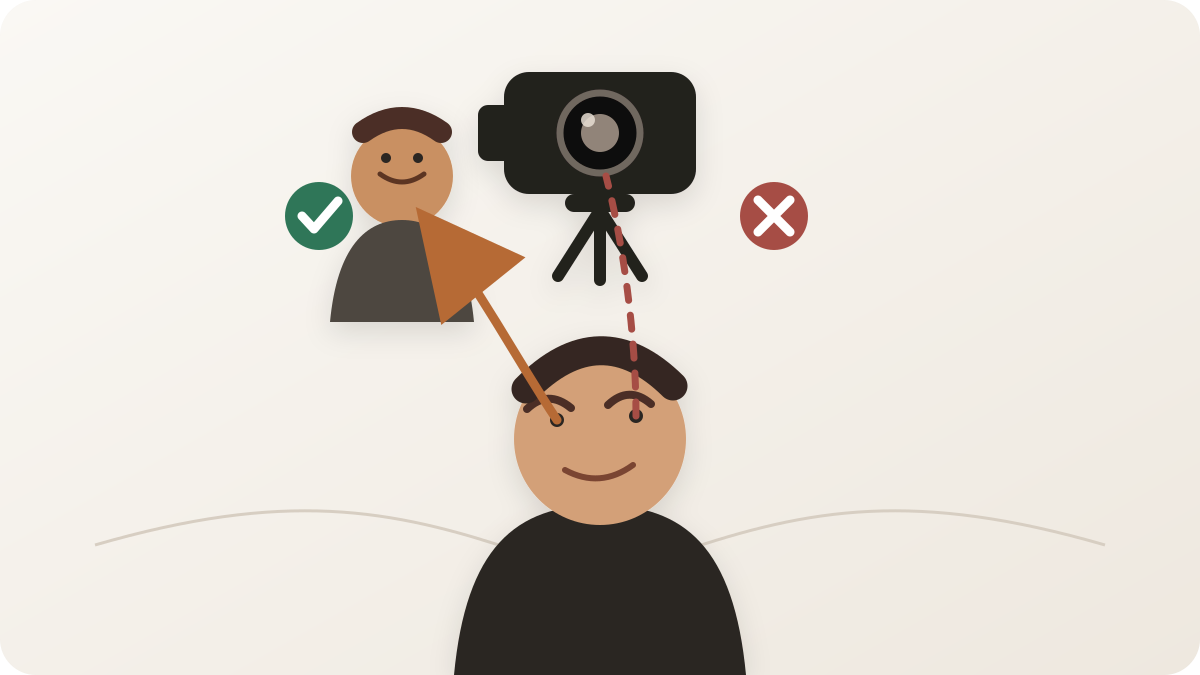
Unless the casting brief says otherwise, Spotlight advises looking just past the camera and keeping the reader near the lens. The instructions for the actual audition always win.
- The target: place your partner right next to the lens (cross-camera), not on the axis.
- The precision: don't stare at a vague point, picture the other person's reactions at that exact spot.
- The consistency: hold your focus. If you break off your target, let it be because your character can't stand the other's gaze anymore, not because you forgot your line.
Three drills for your tapes
The fight (15 min). Phrase your need as one active sentence: "I want him to love me." Play the scene. If the cue you hear doesn't give you what you want, push harder. Your work turns directional instead of spinning in place.
The sound impulse (10 min). Have the other line fed to you. The second the last word lands, fire off yours without thinking about meaning. You let the sound trigger you and short-circuit the mind that judges.
The answer inside listening (5 min). Listen to the line without speaking, and answer in your head with a silent dialogue ("you're lying", "I can't believe this"). Your face comes alive during your silences, and that's what reads on camera.
Where La Réplique fits in
La Réplique runs in your browser (no app to install). You import your text, the tool plays the other roles with natural voices, listens to you and prompts you. For a self-tape:
If a good human reader is available for the take you will send, keep them: the casting directors interviewed by Spotlight prefer another actor to an automated programme. La Réplique is for the times nobody is available, and for running the scene as often as you need before recording.
- Hear it to react. The other lines give you the sound impulse: your lines become responses, not recitation into the void.
- Set your eyeline. Place the sound where your partner would be, so you lock your gaze before the camera is even on.
- Vary the rhythms. Run the scene as many times as you want, at different speeds, until it lives.
And it records the take. The self-tape studio films you on camera straight from your browser, with nothing to install. While you record, the app reads the other roles out loud and that voice is mixed into the final video. A teleprompter shows your current line, and a discreet "Recorded with La Réplique" watermark is added. You get a shareable link to send to casting, with tracking of opens and viewing progress.
What La Réplique does not do: it doesn't replace a coach or a human partner, and it doesn't judge your performance. That part is still on you. Before any of this, learn your lines until they become a reflex.
The mistakes that show on camera
- Searching for words on the ceiling: it snaps the connection with whoever is watching.
- Playing alone: waiting for your cue without being affected by what you hear.
- Freezing your intentions: learning the text with an emotion glued to it stops you from reacting. Learn it neutral.
Sources used
- Self-tape advice from casting professionals — Spotlight
- Roediger and Karpicke, original retrieval-practice study — Psychological Science
- Michael Shurtleff, Audition — publisher page
- Sanford Meisner and Dennis Longwell, Sanford Meisner on Acting — publisher page
- Original study and 2021 replication on context-dependent memory
Bottom line
Nailing a self-tape alone is technical and organic at once. By moving from a solo recitation to a real interaction, you free up your attention. Once your text is a reflex, your eyes light back up. You stop acting. You're there.
Open your script in La Réplique and prep your next self-tape with a real responder, in your browser, no card.
FAQ
Do I need my lines memorized for a self-tape? Know them well enough to keep most of your eye contact on your target, while keeping your sides within reach. Memorizing is there to free your gaze, not to recite.
Why do my eyes look fake on camera? Usually because you have no precise target, or because you're already thinking about your next line instead of listening to the other cue.
Does La Réplique record my video? Yes. The self-tape studio records you from your browser, with the other roles read by the app and mixed into the video, a teleprompter for your lines and a shareable link for casting.
Where do I look if I have several partners? Place them at distinct spots on either side of the lens (cross-camera), to mark the shifts in relationship.
What is silent dialogue? Answering your partner in your head while they speak. It makes your thoughts visible to the camera, even when you say nothing.